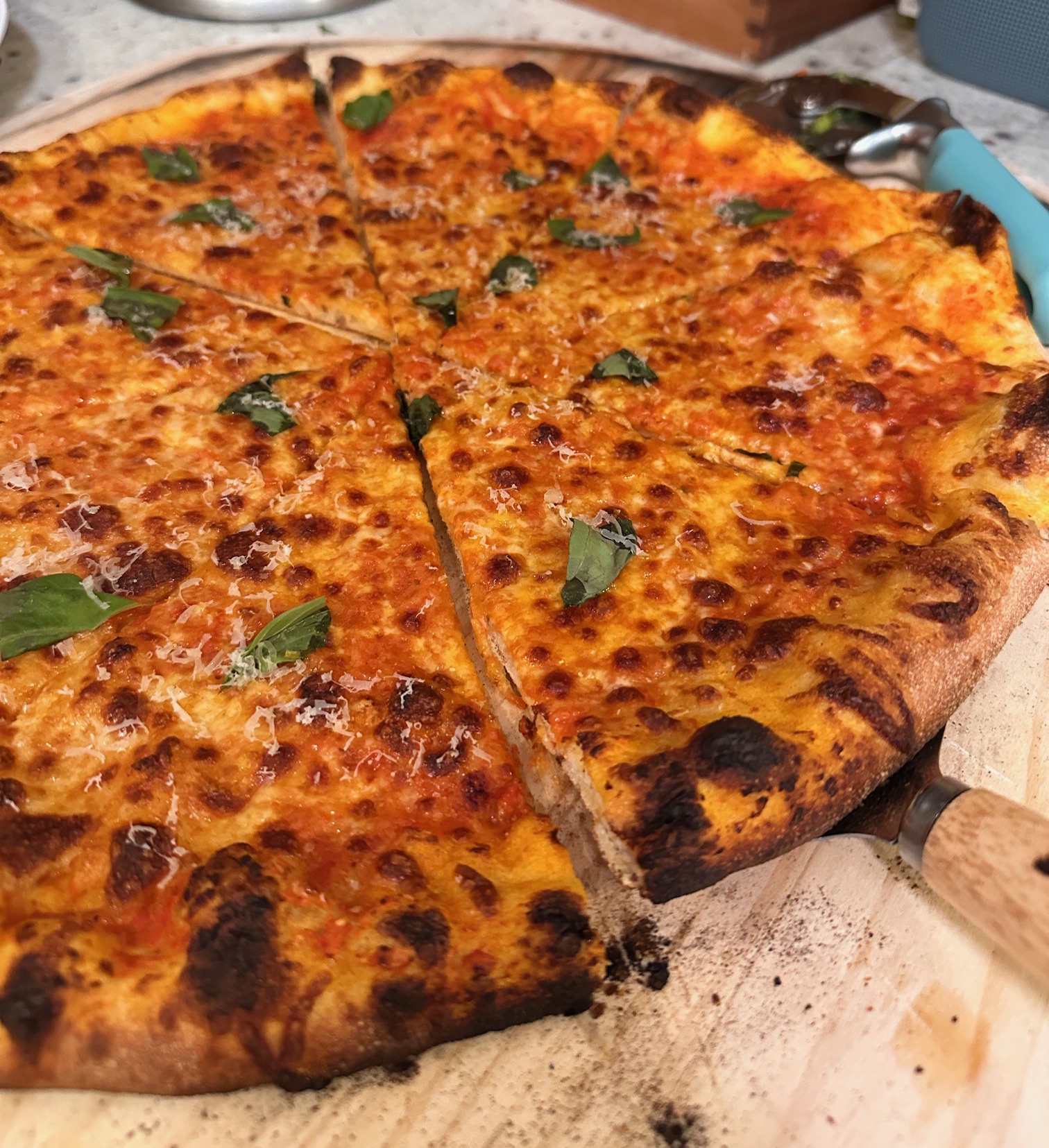
.png)
The pizza I made two weeks ago turned out no better than the first one I ever attempted: two floppy messes with gaping holes in the crust, both improvised into calzones.
The good ones, you enjoy. The bad ones, you try to deconstruct. Sticky? Too little flour on the peel. Holey? Overstretched. Lumpy? Overproofed. Soggy? Too much sauce.
Bad pies provoke questions. They make me want to know more.
Let’s get one thing straight: it's flour, water, salt, and yeast. It shouldn't be this hard—but I’m glad it is.
I'll show you what I mean. First, a little slice of backstory.
It was 2015, and my roommate was cooking two hot dogs in the microwave of our post-grad apartment.
Up to that point, my biggest culinary influences were the films Ratatouille and Julie & Julia. I had no idea what I was doing when I stepped up to the stove and clicked on the burner, but the dull popping of those hot dog skins drove me into the kitchen.
It was a pleasant surprise when my first attempt, chicken parm, came out delicious.
Reality soon set in. For every success, there was a failure. Eggs Benedict, chicken and dumplings, a North African meatball polarizing enough to provoke an argument over the cost of saffron.
But it wasn't until I attempted pizza that I was truly humbled.
Two years and two apartments later, my girlfriend and I were in our own place, figuring each other out. I’d started to gain the confidence—perhaps the hubris—that comes with repeated trial-and-error in the kitchen.
A “simple” dough recipe from a pizzeria in Brooklyn smiled up at me from the New York Times Cooking app. I bought 00 flour and yeast and followed the instructions.
The mixture clung to my fingers as I kneaded it for the prescribed six minutes. When I portioned it out, the dough balls looked nothing like the smooth rounds in the photo. I coaxed one of these shaggy lumps into a rough blob, as close to a circle as I could get without tearing too many holes.
Absent a pizza peel, I improvised with a cutting board and laid out my sauce and toppings. It was ready to cook.
But then the problems compounded.
The dough stuck to the board, jerked on the surface and leapt into the oven, flopping over itself. I poked, prodded, grunted, slammed the oven door shut, and stalked around the kitchen.
I was frustrated. Humiliated. My girlfriend would probably dump me as soon as she saw the mess smoldering in the oven.
Anna (that’s the girlfriend) rushed into the kitchen, snatched the spatula out of my hand and folded what was left of the pie into a rough calzone.
“It's fine,” she said. “It'll taste exactly the same.”
That night felt like a defeat. But the cataclysm only provoked more questions. I've been asking them for eight years since.
How do I stop the pizza from sticking?
How long should I knead the dough?
How can I stretch it without tearing holes?
Why did it burn instantly?
How can I make it more elastic?
How could I make the crust crispier? Softer? Lighter? Thicker?
How could I time the gooeyness of the cheese to coincide with the perfect spotting of the undercarriage?
What’s the best pepperoni, sausage, tomatoes I can get my hands on?
What if we tweaked the salt by a couple grams? Cut out the oil? Hold the oven at 750? Yes, that's working.
What happens if we use chocolate syrup? Good GOD no.
An answer to one question begot a dozen more. I didn't persist out of any moral duty—simple curiosity kept me going, until the curiosity turned into something resembling competence. Friends with new pizza ovens started asking for tips. Photos from past pizza nights show how far I’ve come.
But every so often, the pizza still wins.
A couple of weeks ago, I was stretching a dough ball I'd taken out of the freezer the night before. I could feel it sag and knot between my fists. When it tore in a couple of spots, I patched them up and kept going.
A perfect smearing of red sauce. An even shower of cheese. Meatballs that Anna—now my wife—had made for Christmas.
The gaping mouth of the Ooni oven flickered with its twin flames. I flicked the peel by muscle memory and launched the pizza in a controlled slide onto the stone I'd warmed to an ideal 750 degrees.
Everything looked beautiful. Until I slid the peel under the crust and tore a gaping hole right through the center.
“Oh no,” I said to Anna, who was just inside the door feeding our ten-month-old.
“What?”
“I think,” I bellowed, scraping at the dough, “we have another calzone on our hands.”
I worked intentionally now, flipping the mass of crust back onto itself and turning up the flame to crisp the whole thing.
I'd been humbled again. Pizza had put me in my place, as it had many times before.
Frustrated, I bit into the folded mess. The cheese, sauce, and meatball melded into a delicious filling between a crisp crust.
It wasn’t half bad.
“Yeah,” she said, feeding a strip of crust to the baby. “Do you think it tastes even better this way?”
Even after eight years of pulling, stretching, tearing, burning, saving, perfecting, and messing up again—she'd forgiven every one of these frustrated failures. The pizza was forgiving, too (almost any botch job can become a tasty calzone).
Which leaves me as the only holdout—because sometimes you have to chase the perfect slice for the sake of the chase.
And choose to let it humble you, before you go out and try again.
I created Pizzaland to test your knowledge and troubleshoot your own pizza challenges.
Follow the steps to pizza heaven
Pizza, like life itself, is a product of choices.
Choose wisely—or watch your pie droop into disaster. Don't worry, the pizza forgives you. Eventually.
You've combined your flour, water, salt and yeast in a bowl. It seems like a sticky and unruly mess.
What should you do to the dough?
You've let your dough ferment in the fridge overnight to build up flavor.
When should you take it out to make into pizzas?
You're working your precious dough into a circle—or as close as it'll get to one.
Oh no, the dough is resisting and has torn in a couple of places. What can you do?
You're making your dream pizza, right out of that Pizza Hut commercial. Your stretched dough awaits its glorious toppings.
How much sauce and cheese should you use?
Your topped pizza is sitting on the peel, looking gorgeous. The oven is ripping hot. It's go time.
How do you get it from the peel to the oven?
Your pizza is in the oven. The cheese is bubbling. You're watching it like a hawk—or maybe you got distracted.
When do you pull it out?